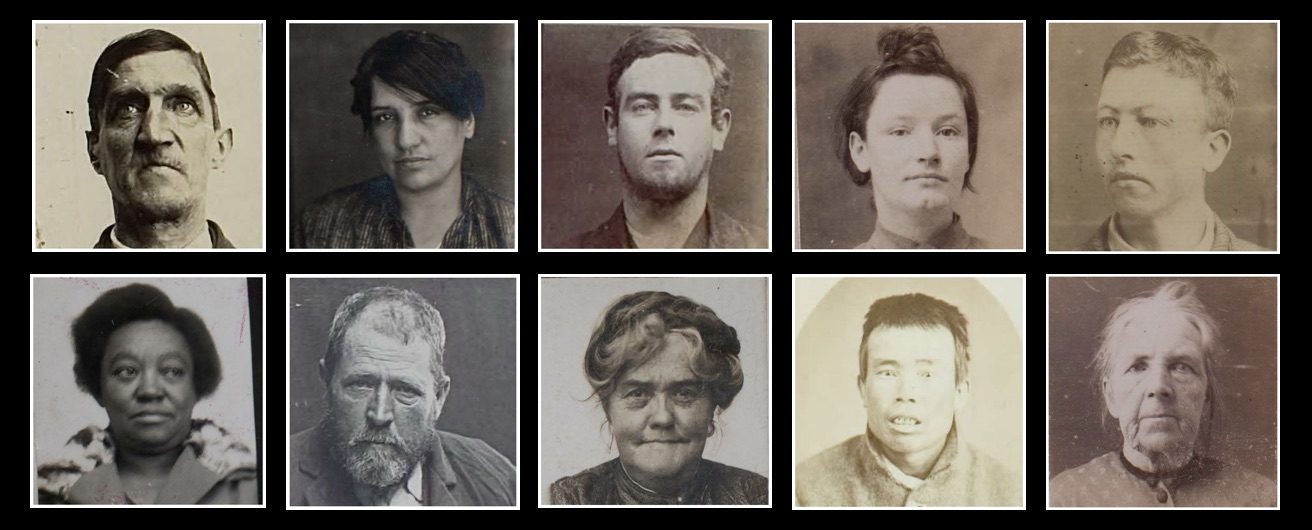
Breaking windows or glass was a specific form of property damage that appeared fairly regularly before colonial courts. In his 1888 book Lights and Shadows of Melbourne Life, John Freeman recorded that smashing windows was one of the favourite amusements of larrikin youths. There is some evidence that it was also used by members of disorderly subcultures in a more targeted way to enact vengeance on others. John Castieau, Superintendent of the Melbourne Gaol, thus noted in his diary in 1870: “Joe Thompson the betting man & the Proprietor of the Continental Cafe came up this afternoon to see a woman who in revenge for not being allowed inside the Cafe took up a stone & smashed one of the large plate glass windows of the establishment; it seems that females are not allowed inside the cafe but that the waitresses who are dressed in fancy costumes are not any better than they should be & consequently the outsiders have a down upon them & their place of business which of course is frequented by most of the loose fish of Melbourne. Thompson is afraid the woman I spoke about will smash his windows again if she is released from prison & he visited her in the hope of inducing her to go to New Zealand where she has friends. Analysis of female prison records from Victoria likewise suggests that most of those convicted of breaking windows were highly recidivist offenders and confirmed members of the criminal underclass.
Breaking windows was an offence under Section 18 Subsection 4 of Victoria’s Police Offences Act 1890:
- Any person who shall commit any of the next following offences shall on conviction pay to the person aggrieved compensation for or the value of the injury done to be assessed by the adjudicating justice to an amount not exceeding in any case Fifty pounds, and shall also be liable to the penalty and punishment hereinafter specified for the cases respectively:—
…iv. And any person wilfully breaking any pane of glass in the window of any building…shall be liable to a penalty not exceeding Twenty pounds or to imprisonment for a period not exceeding three months. Provided that nothing hereinbefore contained shall extend to any case where the person offending acted under a fair and reasonable supposition that he had a right to do the act complained of nor to any trespass (not being wilful and malicious) committed in hunting or the pursuit of game.
References:
Piper, Alana, and Victoria Nagy. “Versatile offending: Criminal careers of female prisoners in Australia, 1860-1920.” Journal of Interdisciplinary History 48, no. 2 (2017): 187-210.